sin
In Ernest Hemingway's The Old Man and the Sea, the concept of sin emerges not as a fixed theological doctrine but as a deeply personal, evolving question that Santiago confronts during his epic struggle with the great marlin. The old man, who is "too simple to wonder when he had attained humility," finds himself in a moral dilemma that forces him to examine the nature of killing, love, pride, and his own place in the natural order. His reflections on sin, triggered by the act of taking the life of a creature he admires, become a central thread in the narrative, revealing the tension between the fisherman's code, religious upbringing, and a more existential, self-justifying philosophy.
The Emergence of the Question
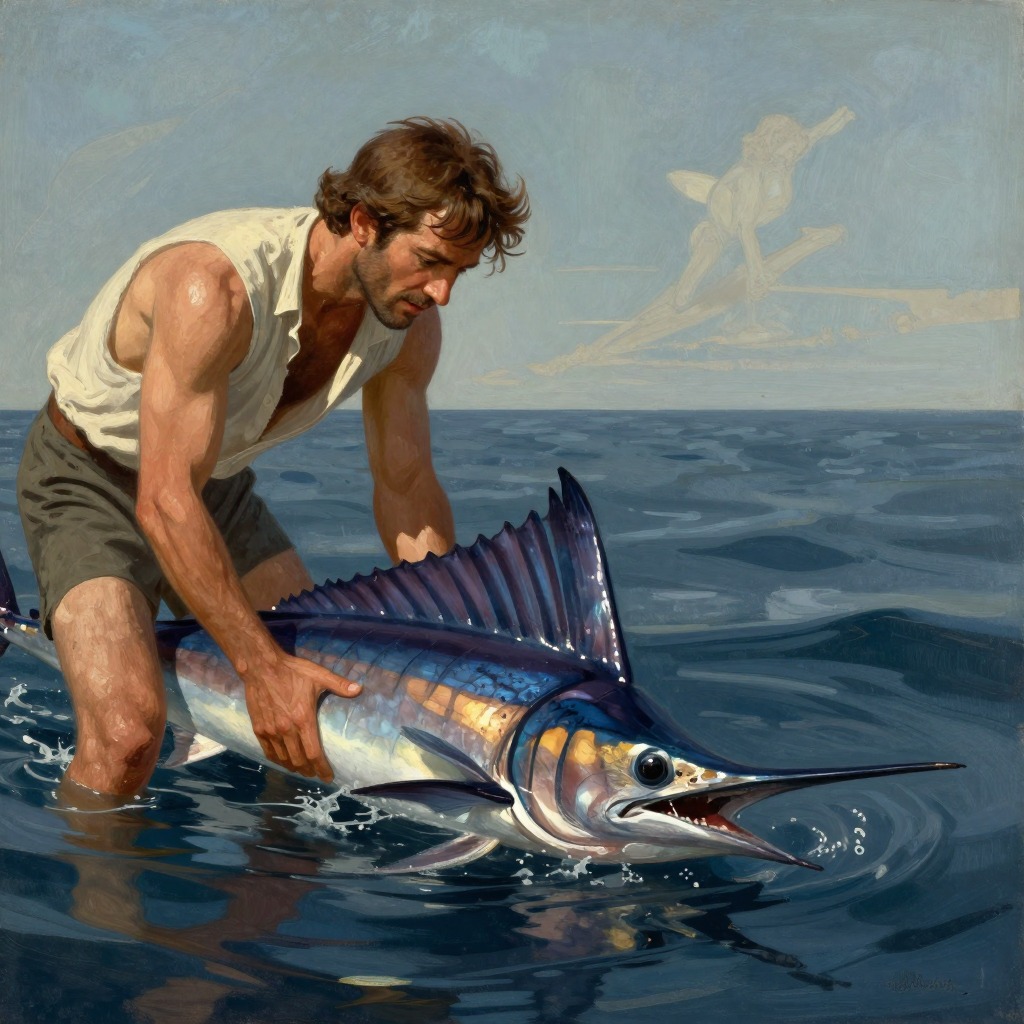
Santiago's meditation on sin begins not in the heat of the battle but after he has killed the marlin and is sailing home, when the first shark attacks. As he watches the mutilated fish, he thinks, "Perhaps it was a sin to kill the fish. I suppose it was even though I did it to keep me alive and feed many people." This thought arises not from a priest's teaching but from his own sense of connection to the fish, whom he has called "brother" and whose dignity he has admired. The old man, who has no radio and nothing to read, "thought much and he kept on thinking about sin," turning the abstract concept over in his mind as the sea and sky provide no answers. He recalls that "San Pedro was a fisherman as was the father of the great DiMaggio," implicitly seeking justification in the lineage of fishermen, yet the question persists.
The Justification of Pride and Love
Santiago's internal debate deepens as he acknowledges that his motives were not purely practical. He admits to himself, "You did not kill the fish only to keep alive and to sell for food. You killed him for pride and because you are a fisherman. You loved him when he was alive and you loved him after." This recognition complicates any simple moral calculus. The old man wonders whether love can absolve the act of killing: "If you love him, it is not a sin to kill him. Or is it more?" The question remains unanswered, suspended between the fisherman's pride in his craft and the genuine affection he feels for his adversary. Earlier, he had declared to the fish, "I love you and respect you very much. But I will kill you dead before this day ends," a statement that encapsulates the paradox at the heart of his profession.
Rejection of Conventional Morality
As the sharks continue to destroy the marlin's carcass, Santiago's thoughts on sin become more dismissive of orthodox religious frameworks. He tells himself, "Do not think about sin. There are enough problems now without sin. Also I have no understanding of it. I am not sure that I believe in it." This is a radical departure from the piety he showed earlier when he promised to make a pilgrimage to the Virgin of Cobre and recited Hail Marys and Our Fathers. The old man's faith, it seems, is practical and situational rather than dogmatic. He even suggests that "everything is a sin," a sweeping generalization that renders the concept meaningless. His final position is one of pragmatic resignation: "Let them think about it," referring to those "who are paid to do it," the priests and theologians who have the luxury of moral abstraction while he must simply endure.
The Sin of Going Too Far
In the aftermath of his defeat, Santiago redefines sin not as the killing of the fish but as the transgression of his own limits. When the boy Manolin asks what beat him, the old man replies, "Nothing. I went out too far." This confession echoes his earlier apology to the fish: "I shouldn't have gone out so far, fish. Neither for you nor for me. I'm sorry, fish." The sin, in Santiago's final reckoning, is not the act of killing but the hubris of venturing beyond the boundaries of his luck and his strength. This interpretation aligns with his earlier observation that "you violated your luck when you went too far outside." The concept of sin thus becomes secularized, tied to the fisherman's code of knowing one's limits rather than to any divine commandment.
Thematic Significance
Santiago's struggle with the concept of sin serves as a microcosm of the novel's larger themes: the dignity of labor, the brotherhood between hunter and hunted, and the existential assertion of meaning in a universe that offers no easy moral absolutes. The old man's inability to settle the question—"I do not understand these things," he admits—reflects Hemingway's own refusal to provide tidy resolutions. Sin, in The Old Man and the Sea, is not a fixed category but a living question that each individual must answer through action and endurance. Santiago's final, exhausted sleep, dreaming of the lions, suggests that the question, while unresolved, has been transcended by the sheer fact of having lived through the ordeal. The concept of sin, like the marlin's skeleton, is stripped down to its essential form, a framework that the old man has filled with his own meaning.